

By Eleonora Matsouka, Social Media Marketing Manager at GIM
Social media search creates new opportunities for businesses. Your next customer may be looking for your product without knowing your business's name.
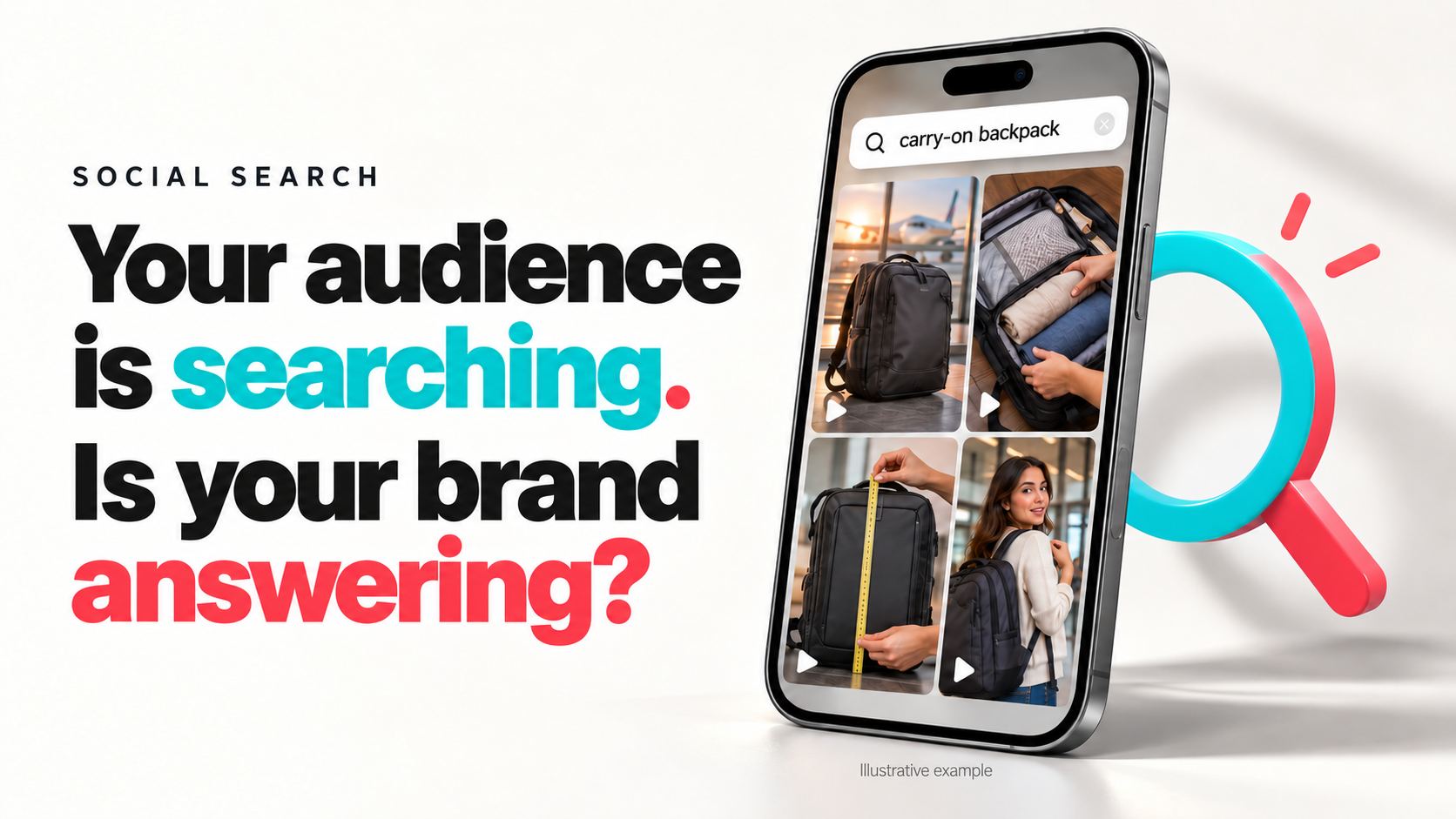
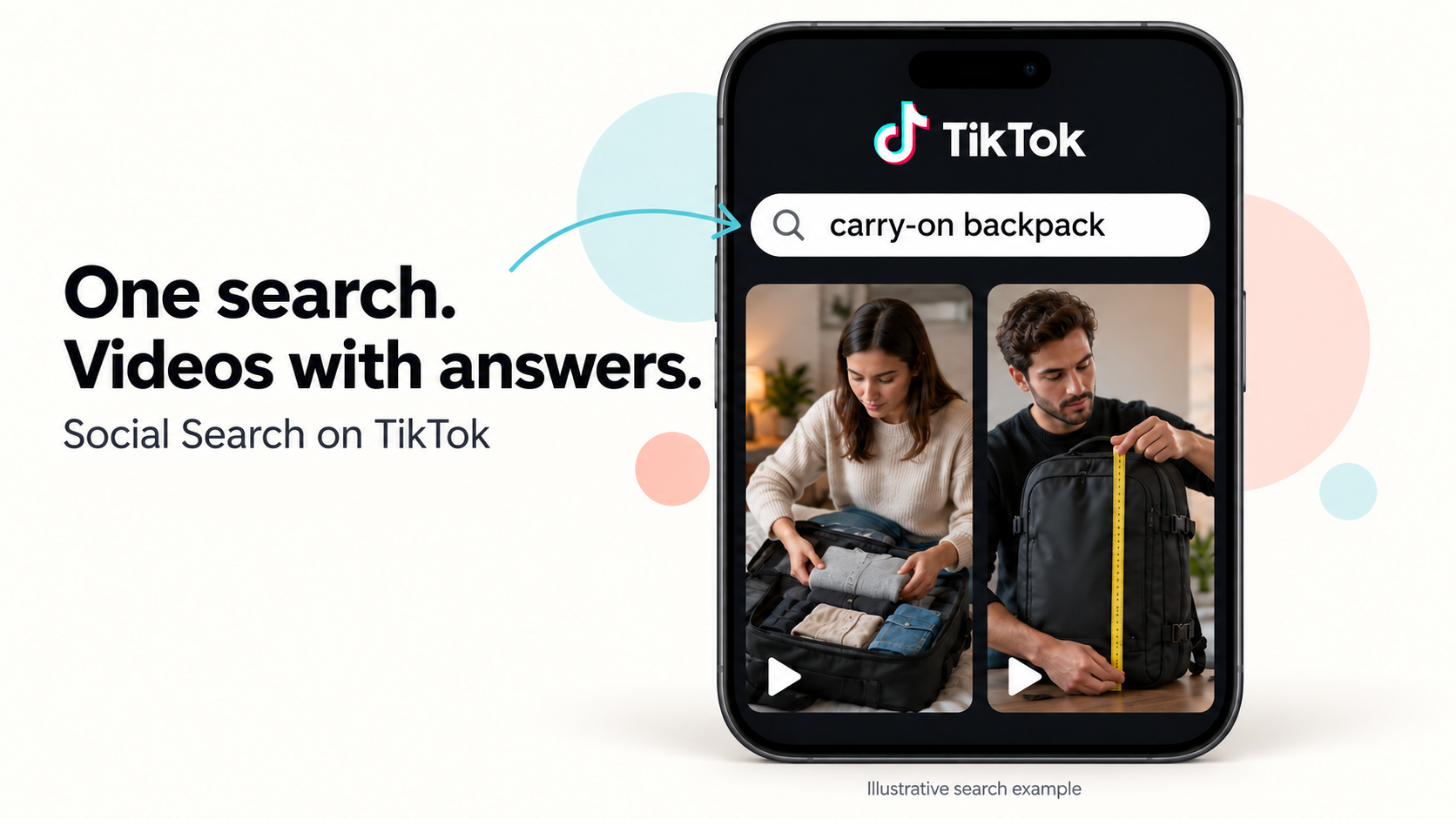
Think of someone planning a trip. They open TikTok search and type ‘carry-on backpack’. They want to explore options, compare sizes or see what actually fits inside.
For a travel accessories retailer, this is an opportunity to offer useful content: a real product test, a demonstration of the dimensions or a clear comparison.
This is Social Search in practice. Someone looks for information within a social platform, and a business's content can become part of their research.
The question for marketers is specific:
When someone searches for something relevant to your business, have you created content that helps them?
What is Social Search, and why does it matter to brands?
Social Search refers to searching for content, information and recommendations within social media platforms.
On TikTok, for example, users can search for content by typing words or phrases. According to the platform, results are influenced by how relevant the content is to the search, the user's interactions, and information such as their language and location.
This behaviour matters for digital marketing because it gives brands another opportunity to connect with people looking for specific information.
In an Adobe Express survey published in February 2026, 49% of the 807 US consumers surveyed said they had used TikTok as a search engine. In the corresponding 2024 survey, the figure was 41%. These findings relate to that specific US sample; they do not measure the Greek market.
The platform is also investing in search as a commercial space. In May 2026, it introduced Search Hubs, branded destinations within search results that combine videos, official accounts and calls to action. These are commercial solutions with availability restrictions, separate from an account's organic presence.
For a Greek business, a practical starting point is to explore the relevant searches and questions coming from its own audience.
What is TikTok SEO?
TikTok SEO means optimising content so it can be found in relevant searches within TikTok.
In practice, it involves researching topics and keywords, presenting the subject clearly and creating content that meets search intent.
Relevance matters. TikTok states that, for most users, content information, including how well a result matches the specific search term, generally carries more weight in search than other factors.
This is not a formula for guaranteed rankings. It does, however, offer a useful direction: every video needs a clear topic and a meaningful answer.
To achieve this, it is worth developing three practical skills.
1. Audience research: Understand the need behind the search
The first skill is understanding what the user needs to learn.
Someone searching for a ‘carry-on backpack’ may be exploring their options. Someone asking ‘what fits in a 40 × 30 × 20 backpack’ has a more specific question.
These phrases are illustrative examples. Research is needed to decide which ones deserve a place in your content calendar.
Where to find content ideas
Start with the questions your business already receives:
- What do customers ask before buying?
- What information do they request in messages?
- Which features need more explanation?
- Which questions keep coming up in the comments?
Build on this with research within the platform. Look at suggested searches, relevant videos and the questions people ask beneath them.
TikTok's Creator Search Insights provides information about topics people search for. It also includes a ‘Content gap’ filter for exploring topics that may need more content. If you have access to the tool, it can support your research.
How does this become content?
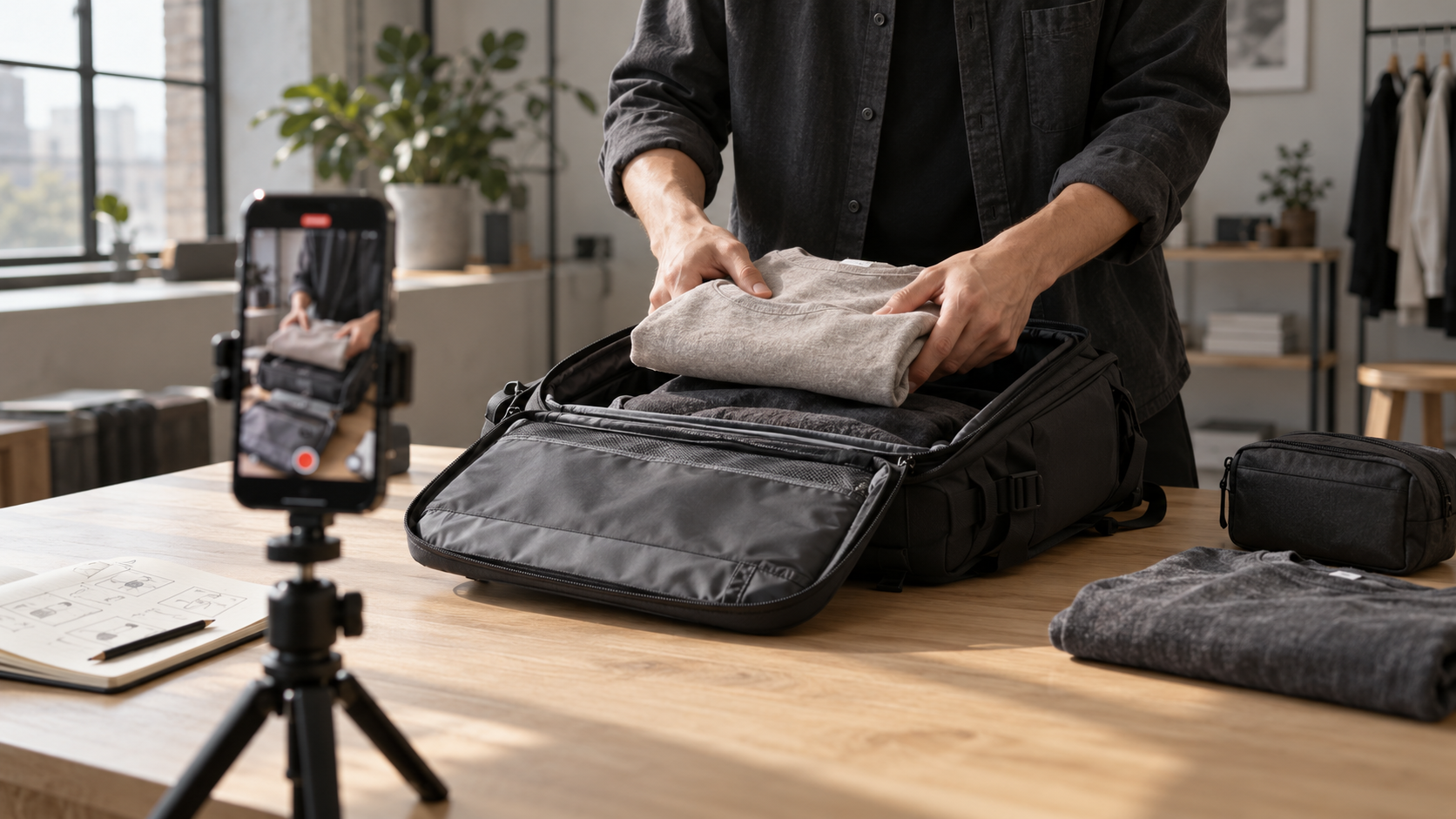
For a travel accessories retailer, a common question about capacity can become a video showing:
- Measurements of the product's dimensions.
- A test using specific items.
- A demonstration of the available compartments.
- An explanation of the limitations the test revealed.
Understanding your customer helps you decide what you need to show.
Try it: Collect ten real customer questions and choose three you can answer with a visual demonstration.
2. Working with AI: Write better briefs and more specific scripts
The second skill is using AI with clear instructions and reviewing its output.
When creating content, you can use it to organise questions, explore different openings and develop an initial script.
The quality of the brief matters. It needs to describe:
- The audience you are addressing.
- The question you want to answer.
- The verified facts you have available.
- The tone and format of the content.
- The action you want the viewer to take next.
Example prompt for a TikTok video
Create a short TikTok script for a travel accessories retailer. The video will show a real test of a backpack's capacity. Start with the question ‘What fits in this backpack?’ Organise the script into shots, narration and on-screen text. Do not add unverified dimensions, features or claims about airline rules. Suggest a structure for the demonstration without assuming its outcome.
Then check the script against the actual product and the footage you have recorded.
Make the topic clear from the start
As a content creation practice, state the topic clearly in the opening text and caption. Include the relevant keyword naturally, without unnecessary repetition.
Check the subtitles too, and make sure the narration matches what viewers see on screen.
The aim is for viewers to understand quickly what they will learn and receive the answer you promised.
Try it: Ask for three openings for the same question. Choose the clearest one that fits your brand's voice and is supported by your material.
3. Critical thinking: Evaluate performance against the goal

The third skill is interpreting data in the right context.
Views show the scale of viewing. But to evaluate a video that answers a product question, you also need to consider what happens next.
Does the viewer stay until the answer? Do they ask for more information? Do they visit the profile or product page?
Which KPIs should you track?
Choose performance indicators based on your goal and the analytics available:
- Watch time and video completion: To assess whether the content holds people's attention.
- Saves and meaningful comments: As signs of usefulness and interest.
- Profile visits and clicks: To track the next steps in the journey.
- Enquiries and purchases: Where appropriate tracking is in place and the source can be identified.
Creator Search Insights also offers Search analytics to track how posts perform in search results.
When directing visitors to your website, use links with UTM parameters wherever possible. This helps you distinguish traffic from that particular activity in your analytics.
Pay attention to the rest of the experience too: the product in the video, the landing page and the purchasing information need to be consistent.
Try it: Publish a short series of videos addressing different questions about the same product. Compare their results over the same time period, taking any paid support or other promotional activity into account.
Your next idea may be in your customers' questions
Social Search adds a useful perspective to your social media strategy: each post can answer something your audience already wants to know.
Research helps you identify the need. A specific brief turns it into content. Evaluation shows what is worth developing further.
Before planning your next TikTok video, listen to your customers' questions. Choose one and give the clearest, best-supported answer you can.
Which question do you hear most often from your customers that could become your next video?